History of Morse Code: How Dots and Dashes Changed the World
The history of Morse code begins not with a scientist in a laboratory, but with an American painter on a ship. In 1832, Samuel Morse was sailing home from Europe when he overheard passengers discussing electromagnetism — and by voyage’s end he had sketched the first idea of the electric telegraph in his notebook.
What followed was one of the most consequential inventions in communication history: a code of short and long signals that carried news across continents, guided ships through storms, coordinated armies in two world wars, and survived nearly two centuries into the digital age. From the first dots and dashes of 1844 to the ham radio operators who still key Morse today — this is the complete story.
Who Invented Morse Code?
The name tells only half the story. Samuel Morse, a portrait painter and professor, championed the electric telegraph and gave the code its name — but the dot-dash system as we use it owes an enormous debt to his partner, machinist Alfred Vail.
Morse had the vision but little technical skill. Vail built the practical equipment and made the code’s cleverest design decision: give the shortest patterns to the most frequently used letters. That is why E is a single dot and rare Q gets a four-signal pattern — data compression a century before computers. See it in our complete morse code alphabet guide.
When Was Morse Code Invented? The Road to 1844
Morse code arrived in stages:
- 1832 — Morse conceives the telegraph idea aboard the ship Sully.
- 1837 — A working one-wire model is demonstrated; early versions used a ticker-tape zigzag decoded with a printed dictionary.
- 1838 — Vail’s dot-dash system is shown publicly; Morse transmits about 10 words per minute at a New York exhibition.
- 1840 — Morse applies for a patent on his telegraph.
- 1843 — After years of lobbying, Congress grants $30,000 to build a telegraph line between Washington, D.C. and Baltimore.
- May 24, 1844 — The first official long-distance message is sent, and Morse code history truly begins.
Morse’s first design encoded whole words as numbers to look up in a book — clunky. Vail’s refinement, giving every letter its own dot-dash pattern, made the system fast enough to survive.
The First Message: “What Hath God Wrought”
On May 24, 1844, Morse sat in the U.S. Capitol in Washington while Vail waited 40 miles away in Baltimore. For the public demonstration, Annie Ellsworth — the young daughter of the patent commissioner — suggested a biblical phrase: “What hath God wrought.”
Morse keyed it in; seconds later, Vail keyed the same message back. For the first time in history, complex thoughts had traveled dozens of miles almost instantaneously. Type the phrase into our free morse code translator and play it as audio — those are the same rhythms Vail heard in 1844.
American Morse Code vs International Morse Code
The original American Morse code used intra-character pauses and different letter patterns — fine on wires, awkward for wireless. In 1851 a European conference simplified it, and the ITU standardized the improved version in 1865. That revision — International Morse code — became the worldwide standard, while American Morse faded with the wired telegraphs it served.
Morse Code at Sea: SOS and the Titanic
When wireless radio reached ships in the early 1900s, Morse code became the language of the sea — and it needed a universal distress signal, because each company used its own. The 1906 Berlin Radiotelegraph Convention adopted SOS (three dots, three dashes, three dots), effective worldwide from July 1, 1908.
SOS officially stands for nothing — not “Save Our Souls.” It was chosen for pure engineering: the pattern is simple, symmetrical, and nearly impossible to mistake, even through heavy static. Then came April 1912: as the Titanic sank, operators Jack Phillips and Harold Bride sent both the older CQD and the new SOS. The disaster burned the signal into the world’s memory and pushed stricter rules for ships keeping a permanent radio watch. We break down the signal itself in our guide on how to signal SOS in morse code.
Morse Code in World War 2
Both world wars ran on Morse code, but Morse code in World War 2 reached an extraordinary scale: frontline units radioed headquarters in CW Morse, resistance groups in occupied Europe coordinated with London through clandestine sets, and vast intercept stations listened around the clock to enemy traffic.
Skilled operators were among the most valued personnel in every military. Ironically, the war also accelerated the voice and digital radio technologies that would later push Morse out of professional use — but in the moment, nothing beat a signal that could punch through interference and be copied by any trained ear on earth.
Is Morse Code Still Used Today?
Yes — in niches where nothing else works as well. Aviation navigation beacons still identify themselves in Morse for pilots to recognize. Ham radio operators use it daily, because a faint CW signal can cross an ocean on 5 watts where voice fails. Emergency planners keep it as a low-tech fallback, and it remains a popular accessibility input method. Search interest keeps climbing in 2026 — and if the history inspired you, our beginner’s guide to learn morse code will have you tapping your first letters today.
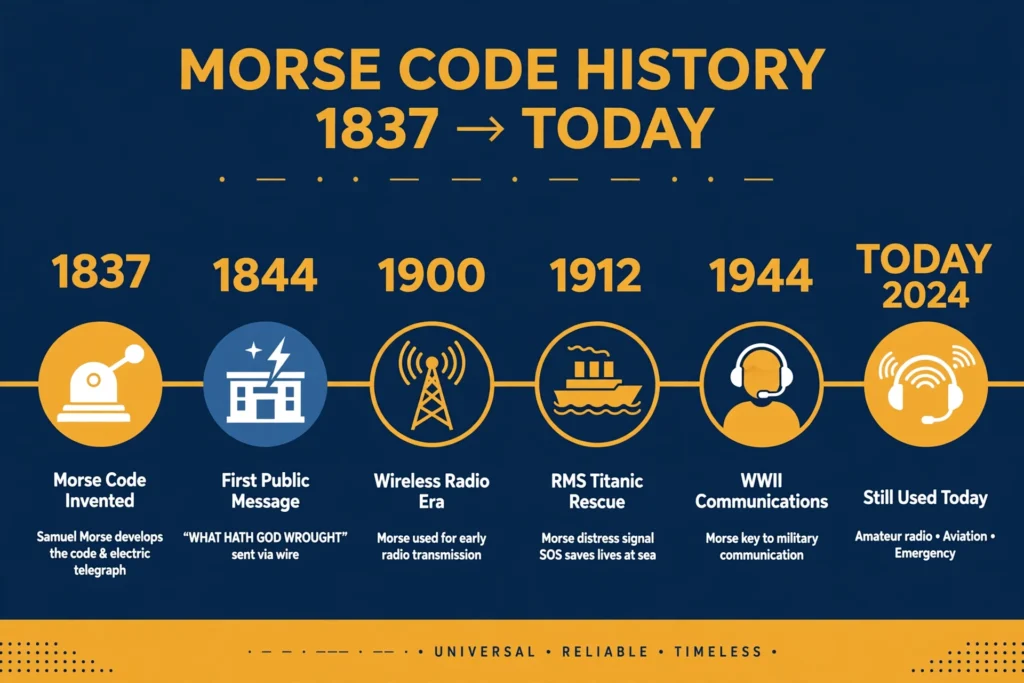
Key dates: 1832 — Morse conceives the telegraph · 1844 — first message “What hath God wrought” · 1865 — International Morse standardized · 1908 — SOS becomes the distress standard · 1940s — Morse carries WWII traffic · 2026 — ham radio keeps it alive.
History of Morse Code: FAQs
Who invented Morse code?
Samuel Morse gave the code its name, but his partner Alfred Vail designed the actual dot-dash letter system — including the frequency-based assignment that made it efficient.
When was Morse code invented?
Developed between 1836 and 1838; the first official message was sent on May 24, 1844, and International Morse was standardized in 1865.
What was the first Morse code message?
“What hath God wrought” — sent by Morse from Washington to Vail in Baltimore on May 24, 1844, on a phrase suggested by Annie Ellsworth.
What is the difference between American and International Morse code?
American Morse was the original 19th-century variant with intra-character pauses; International Morse (standardized 1865) is the simplified worldwide standard used ever since.
Is Morse code still used today?
Yes — by ham radio operators, aviation navigation beacons, emergency planners, and accessibility tools. It left professional licensing requirements in 2003 but survives on merit.
From Dots and Dashes to the Digital Age
The history of Morse code is really the history of instant communication itself: a painter’s shipboard idea became the telegraph, and the humble dot and dash turned out to be one of the most efficient encodings humans ever devised.
Nearly 190 years after “What hath God wrought,” the code still works exactly as designed. Type any message into our free morse code translator and listen — you are hearing the same rhythms that crossed the first wire in 1844.