
Morse Code Alphabet: A–Z Chart & How to Learn It
The Morse code alphabet is the foundation of the world’s most famous dot-and-dash language. Every letter from A to Z has its own unique pattern of short signals (dots) and long signals (dashes). Learn these 26 patterns, and you can encode or decode any English message — by sound, by light, or by hand.
In this guide you’ll find a complete Morse code alphabet chart, the spoken “di-dah” sounds radio operators actually use, the timing rules that keep your signals readable, and a proven 5-step method to memorize the whole alphabet in days rather than months.
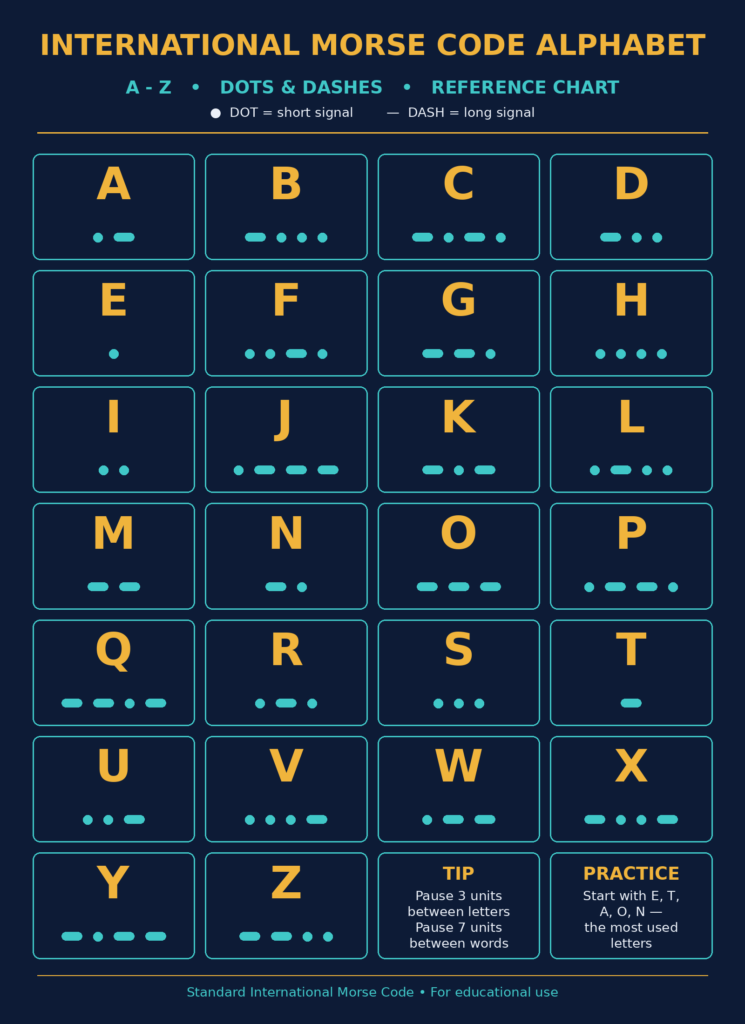
Morse Code Alphabet Chart: A to Z
Below is the complete International Morse code alphabet. The “spoken as” column shows how radio operators voice each letter — say these rhythms out loud while you practice, because hearing the pattern is far more effective than staring at dots and dashes.
| Letter | Morse code | Spoken as |
|---|---|---|
| A | .- | di-dah |
| B | -… | dah-di-di-dit |
| C | -.-. | dah-di-dah-dit |
| D | -.. | dah-di-dit |
| E | . | dit |
| F | ..-. | di-di-dah-dit |
| G | –. | dah-dah-dit |
| H | …. | di-di-di-dit |
| I | .. | di-dit |
| J | .— | di-dah-dah-dah |
| K | -.- | dah-di-dah |
| L | .-.. | di-dah-di-dit |
| M | — | dah-dah |
| N | -. | dah-dit |
| O | — | dah-dah-dah |
| P | .–. | di-dah-dah-dit |
| Q | –.- | dah-dah-di-dah |
| R | .-. | di-dah-dit |
| S | … | di-di-dit |
| T | – | dah |
| U | ..- | di-di-dah |
| V | …- | di-di-di-dah |
| W | .– | di-dah-dah |
| X | -..- | dah-di-di-dah |
| Y | -.– | dah-di-dah-dah |
| Z | –.. | dah-dah-di-dit |
How to Read the Morse Code Alphabet Chart
Every character in the chart is built from just two building blocks. A dot is a short signal lasting one time unit; a dash is a long signal lasting three time units. Within a single letter, the gap between dots and dashes is one unit. That is the entire system — everything else is just combinations.
This chart uses International Morse code, the standard defined by the ITU and used worldwide today. An older variant, American Morse code (sometimes called railroad Morse), used extra intra-character spacing and different patterns for some letters, but it is now obsolete. Whenever you see a Morse code alphabet chart online, it almost certainly shows the international version — including the one above.
Morse Code Alphabet Sounds: How Operators Say Each Letter
Experienced radio operators don’t think in dots and dashes — they think in rhythm. Saying each letter’s pattern aloud as “di” (short) and “dah” (long) turns a visual puzzle into a sound you can recognize instantly, even at speed.
Try it now: E is “dit” (one quick tap), T is “dah” (one long tone), S is “di-di-dit” (three quick taps), and O is “dah-dah-dah” (three long tones). Put S and O together and you get the most famous rhythm on earth: the SOS distress signal, … — ….
Learning the Morse code alphabet by sound has a practical payoff. In real use — a radio, a flashing light, a tapped wall — you hear or see signals in time, not on paper. Train your ear from day one and the chart above becomes a reference you rarely need.
Morse Code Timing Rules: The 1-3-7 System
A chart of letters is only half the story. Without correct spacing, … — … dissolves into meaningless noise. The timing rules are simple and worth memorizing alongside the alphabet:
- 1 unit — the length of a dot, and the gap between signals inside one letter.
- 3 units — the length of a dash, and the gap between letters.
- 7 units — the gap between words.
So the word “SOS” is sent as three dots, a 3-unit pause, three dashes, a 3-unit pause, three dots. Get the pauses right and anyone with a chart can read you; get them wrong and even experts will struggle. We cover the full system in detail in our Morse code timing rules guide.
Beyond Letters: Morse Code Numbers and Punctuation
Once you know the 26 letters, the rest of the code opens up quickly. Morse code numbers follow a beautifully logical pattern: every digit is exactly five signals long, and the number of leading dots tells you the digit. 1 is .—-, 2 is ..—, and so on up to 5, which is ….. (all dots). Then the pattern mirrors: 6 is -…., and 0 is —– (all dashes).
Punctuation marks exist too — the period is .-.-.-, the comma is –..–, and the question mark is ..–.. — but they are longer and used less often. Master the alphabet first; numbers and punctuation take an afternoon once the letters are solid.
How to Learn the Morse Code Alphabet Fast: A 5-Step Method
Don’t try to memorize the chart top to bottom. Use this method instead — it’s how radio clubs have taught beginners for decades:
- Start with the shortest letters. Learn E (.), T (-), A (.-), I (..), M (–), and N (-.) first. These six appear constantly in English, so you’ll use them immediately.
- Learn by sound, not by sight. Say “di-dah” aloud for every letter and tap the rhythm on the table. Sound-based learning sticks far better than staring at the chart.
- Practice in short daily sessions. Ten focused minutes a day beats a two-hour weekend cram. Spaced repetition is what moves patterns into long-term memory.
- Spell real words. Write your name, your city, and classic words like SOS in code. Real words give the abstract patterns something to attach to.
- Test yourself with a translator. Type a sentence into a Morse code translator, then decode the output back to text without peeking. That loop is the fastest way to find your weak letters.
For more hands-on techniques — mnemonics, listening drills, and manual tapping exercises — see our complete Morse code learning guide.
Practice with a Morse Code Alphabet Translator
A chart teaches you the alphabet; a translator makes it usable. Type any text into our free Morse code translator to see it converted instantly, listen to the audio playback at your own speed, and decode Morse back into plain English. Use it to check your homework as you work through the 5-step method above — it’s the fastest feedback loop a beginner can get.
Morse Code Alphabet FAQ
How long does it take to learn the Morse code alphabet?
Most learners can recognize all 26 letters within one to two weeks of ten-minute daily practice. Reaching a comfortable receiving speed of 10–15 words per minute typically takes a few months.
Is the Morse code alphabet still used today?
Yes. Amateur radio operators use it daily, aviation beacons identify themselves in Morse, it serves as an accessibility input method, and SOS (… — …) remains the universally recognized distress signal.
What is the difference between International and American Morse code?
American Morse is an older 19th-century variant with different patterns and intra-character gaps; International Morse is the modern worldwide standard shown in the chart above.
What is A in Morse code?
A is .- — spoken “di-dah.” It’s one of the first letters beginners learn because it’s short and extremely common in English.
Start With the Chart, Stay for the Rhythm
The Morse code alphabet looks like 26 patterns to memorize, but it’s really one small system of dots, dashes, and pauses — and the shortest codes belong to the letters you’ll use most. Bookmark the chart above, practice ten minutes a day with the 5-step method, and test yourself on our translator. In two weeks, you’ll be reading dots and dashes like a second language.