Ham Radio Morse Code: Why Hams Still Use CW (and How to Start)
Ham radio Morse code — which operators call CW — is one of the oldest technologies still in daily use on the air. Tune to the bottom end of any HF ham band and you will hear it: a stream of beeps spelling out callsigns, reports, and greetings, sent by hand with nothing more than an on-off switch. And this is not a museum exhibit. A large share of today’s ham radio operators choose CW deliberately, because physics is on its side. This guide explains what CW is, why hams refuse to give it up, and exactly how you can join them.
What Is CW in Ham Radio?
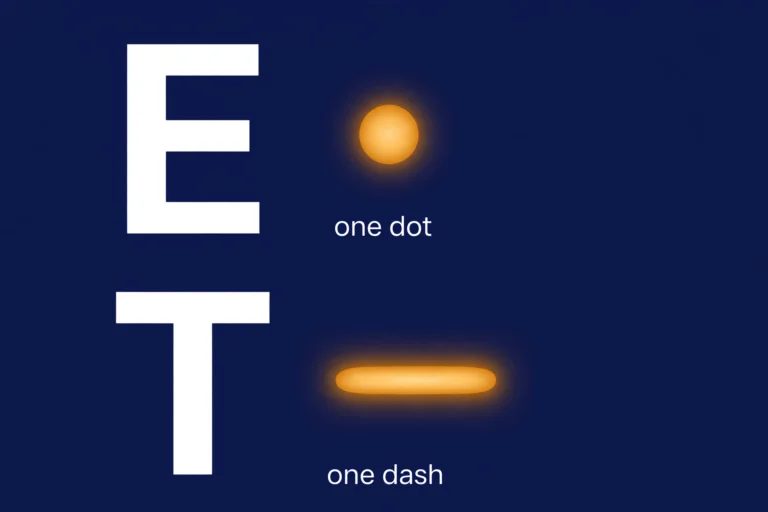
CW stands for continuous wave. On a ham radio, a CW transmission is a single tone that the operator switches on and off in the rhythm of Morse code: a short burst (dit) and a longer burst (dah). Hams use the words Morse and CW interchangeably — they mean the same thing on the air.
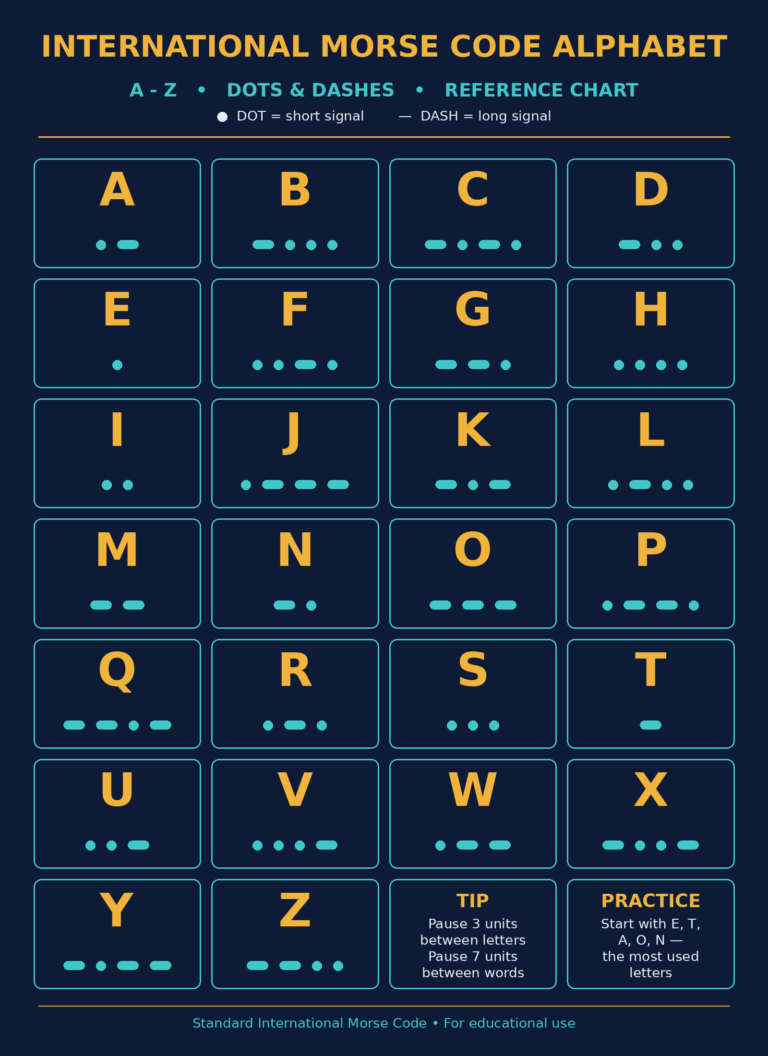
Receiving CW is a listening skill. Instead of reading dots and dashes on paper, operators learn to recognize the sound of each character, the way you recognize a word in spoken language. A beginner might count individual dits and dahs, but experienced operators hear whole letters and words as rhythmic patterns. If you are just starting out, our morse code alphabet guide is a good place to build that foundation before you touch a radio.
Why Do Ham Radio Operators Use Morse Code?
The reason is not nostalgia — it is physics, and it is dramatic.
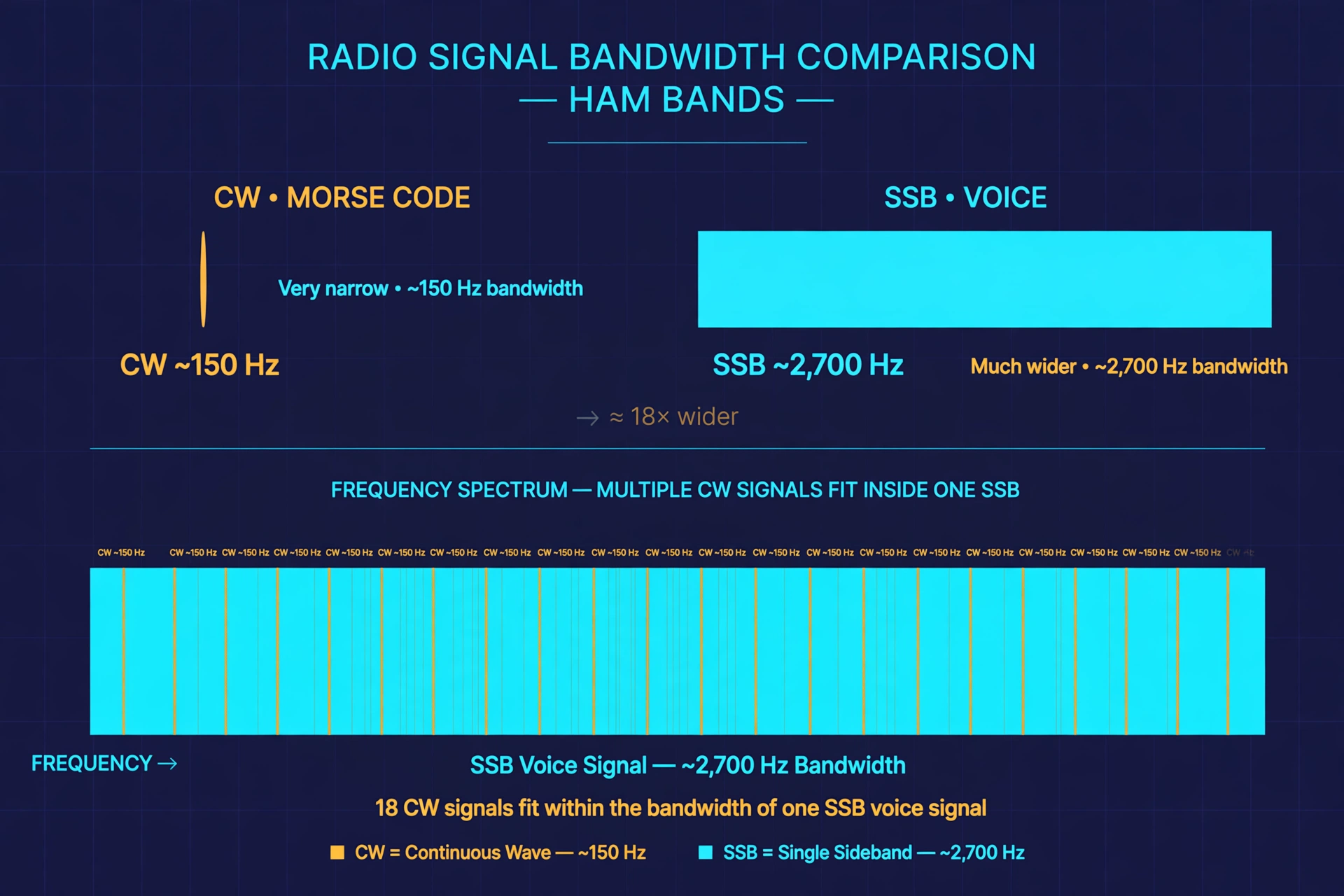
1. It cuts through noise that kills voice signals. A CW signal at 20 words per minute occupies only about 100–150 Hz of bandwidth. A voice (SSB) signal needs roughly 2,700 Hz — about 18 times more. Because the receiver concentrates all its energy on that narrow slice, CW enjoys a signal-to-noise advantage of roughly 14 dB over voice. In plain terms: when a voice contact dissolves into static, the same station on CW is often still perfectly readable. That is why DXpeditions to rare, hard-to-reach locations log most of their contacts on CW.
2. Tiny power goes a long way (QRP). QRP means transmitting at 5 watts or less — and on CW, that routinely crosses oceans. SOTA (Summits on the Air) activators on mountaintops and emergency operators running on batteries depend on exactly this.
3. Simplicity and resilience. The entire transmitter can be a couple of wires and a key. The IARU’s emergency communications guidance still lists CW as the mode of last resort, because it works with damaged equipment and no computer, sound card, or internet required.
4. A universal shorthand. CW contacts lean on short abbreviations and Q-codes (like QRS = “send slower”, QTH = location, RST = signal report), so two operators who share no language can still complete a contact. It is also protected by international regulation: CW keeps a primary allocation on every amateur HF band.
Do You Need Morse Code for a Ham Radio License?
No — and this surprises many beginners. The FCC dropped the Morse requirement for US licenses in 2007, and the ITU removed the international requirement back in 2003; most countries followed. Today Morse is completely optional for getting licensed.
Yet operators keep learning it anyway. An ARRL survey found that over 40% of new technicians learn CW specifically to use it on HF — nothing in the rulebook forces them, the mode simply earns its place. For the earlier story, see our history of morse code, from the 1844 telegraph to the modern ham bands.
How to Learn Morse Code for Ham Radio
Learn it by sound, not by sight. The two methods almost every CW academy teaches are:
The Koch method — start with just two characters (usually K and M) at full target speed, and add one new character every few days only once you can copy the current set at 90% accuracy. You never slow the characters down; you only widen the gaps between them.
Farnsworth timing — characters sent at a brisk 15–20 WPM, but with stretched spacing between them. This trains your ear to recognize patterns instead of counting dits, which is why modern learners progress far faster than old tape-course students.
A practical plan: 15–20 focused minutes a day beats marathon weekend sessions. Free tools like LCWO.net (Koch trainer) and the CWops CW Academy (free live classes each semester) cover the whole path. Expect basic proficiency around 10–13 WPM within two to three months of daily practice. For the detailed walkthrough, see our complete beginner’s guide to learning morse code and the morse code timing rules that make Farnsworth work.
What Speed Do You Need on the Air?
Most comfortable, conversational CW contacts (QSOs) happen at 10–13 WPM. That is the target to aim for — not 25, not 40. Contesters run much faster, but nobody expects it from a newcomer.
And if someone answers you too fast, that is what QRS PSE is for — it politely asks them to slow down. Experienced operators happily drop to 5 WPM for a newcomer. The real milestone is “head copy”: understanding words without writing every character down, which arrives gradually around 13 WPM.
Where to Find CW on the Ham Bands
CW lives at the bottom end of each HF band, where the band plans reserve it. Popular spots to listen:
- 40 meters: 7.000–7.040 MHz (a beginner hangout)
- 20 meters: 14.000–14.070 MHz (long-distance DX territory)
- 80 meters: around 3.500–3.575 MHz (evening local and regional contacts)
No radio yet? No problem — you can hear live CW right now on a free WebSDR site in your browser. Tune to one of those segments, set the mode to CW, and listen to real operators in real time. It is the cheapest possible ear training, and it will show you how musical the mode actually sounds.
Your First CW Contact
A typical beginner QSO is shorter than you fear: callsigns, a signal report (599 is the classic “loud and clear”), a name, a location, and 73 — the traditional “best regards” — to close. A first contact can be six short exchanges. Clubs like SKCC and the Long Island CW Club run slow-speed nets and mentor programs built exactly for this moment.
Frequently Asked Questions
Is CW the same as Morse code?
On ham radio, yes. CW (continuous wave) is the transmission method — keying a tone on and off — and Morse code is the alphabet it spells.
Can I learn Morse code for free?
Yes. LCWO.net offers free Koch-method training, the CWops CW Academy runs free classes each semester, and ARRL station W1AW broadcasts code practice on a published schedule.
How long does it take to learn CW?
With daily practice, most learners reach 10–13 WPM — enough for real contacts — in about two to three months. Comfortable head copy typically takes three to six months.
What does QRP mean in ham radio?
Transmitting at 5 watts or less. CW is the mode where QRP shines: its narrow bandwidth lets a 5-watt signal span oceans.