Morse Code Prosigns: The Complete List & Meanings
Morse code prosigns are the hidden punctuation of the code — short signals that tell the other operator “message over,” “wait a moment,” or “I’m signing off.” If you have ever heard a burst on a ham radio conversation that matched no letter, you were probably hearing a prosign. This guide lists every common prosign, its meaning, and how to send it.

Prosigns matter because Morse code is more than letters: letters carry the message, but prosigns carry the conversation — opening it, breaking it into parts, and closing it cleanly.
What Are Morse Code Prosigns?
A prosign (short for “procedural signal”) is two or three letters sent together as one continuous symbol, with no gap between the letters. Written down, prosigns are shown with a bar over the letters, like AR, or in angle brackets, like <AR> — that bar tells you the letters belong together and must be sent as a single unit.
Compare ordinary letters, where every letter is separated by a short gap. In a prosign, that gap disappears: A followed by R sounds like “di-dah, di-dah-dit” with a pause in the middle, while the prosign AR sounds like “di-dah-di-dah-dit” in one flowing run. Your ear learns that difference with practice.
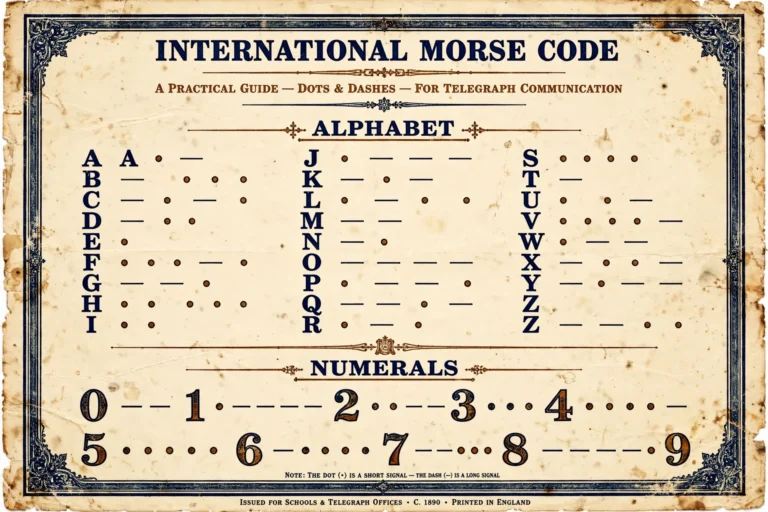
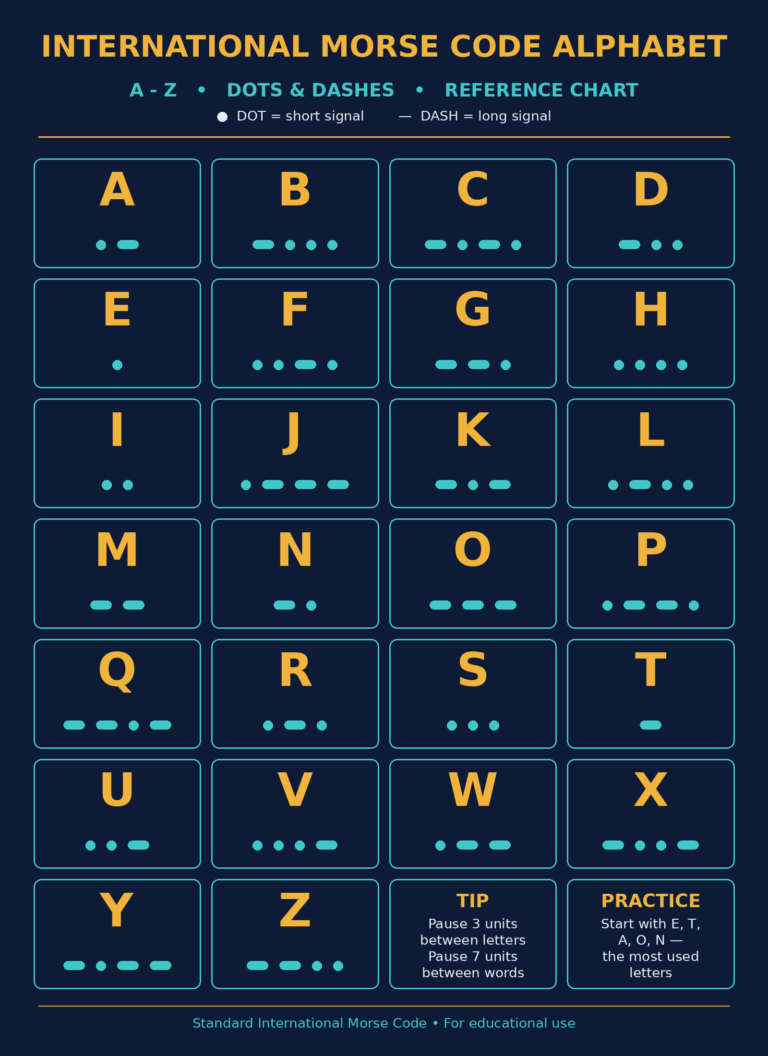
Prosigns are not secret codes or extra letters. They are practical tools from telegraphy and ham radio, where operators needed a fast, agreed way to manage a contact: who talks next, when a message ends, when to wait, when it is over. The Morse code alphabet gives you the letters; prosigns give you the manners.
The Complete Morse Code Prosigns List
Here are the prosigns you will actually meet on the air — learn AR, SK, BT, and AS first, since those four cover most everyday contacts.
| Prosign | Pattern | Sounds like | Meaning |
|---|---|---|---|
| AA | .−.− | di-dah-di-dah | New line — move down one line |
| AR | .−.−. | di-dah-di-dah-dit | End of message |
| AS | .−… | di-dah-di-di-dit | Wait / stand by |
| BT | −…− | dah-di-di-di-dah | New paragraph / break between sections |
| CT (KA) | −.−.− | dah-di-dah-di-dah | Start of transmission / attention |
| K | −.− | dah-di-dah | Go ahead — invitation for any station to transmit |
| KN | −.−−. | dah-di-dah-dah-dit | Go ahead — invitation for one named station only |
| CL | −.−..−.. | dah-di-dah-di-di-dah-di-dit | Closing down — going off the air |
| HH | …….. | eight dits | Error — correction follows |
| SN (VE) | …−. | di-di-di-dah-dit | Understood / verified |
| SK (VA) | …−.− | di-di-di-dah-di-dah | End of contact |
One famous signal belongs in this family too: SOS is technically a prosign, but it has its own strict rules and history, so we cover it separately in our SOS distress signal guide.
How to Send Prosigns Correctly
The single rule that makes a prosign a prosign is the missing gap. When you send AR, do not pause between the A and the R: the letters run together into one symbol, as if they were a single character. Leave a normal letter gap and the receiver hears two letters — A, then R — and the signal loses its meaning.
That is why beginners misread prosigns at first: your brain splits everything into letters, so AR looks like two letters until your ear learns the joined rhythm. Fix it with simple listening practice — hear AR as one sound (“di-dah-di-dah-dit”), not as two. Our timing rules guide explains the gaps: one unit inside a character, three between letters, seven between words. A prosign uses inside-a-character spacing throughout.
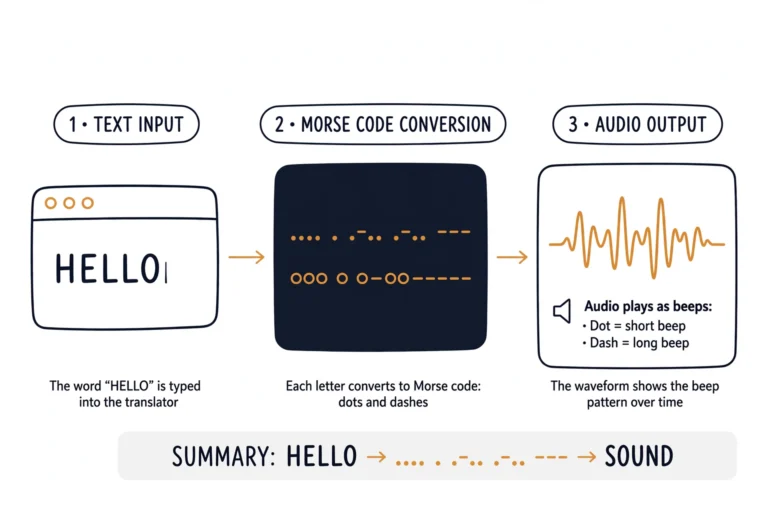
To hear the difference yourself, open our free Morse code translator, type AR, and compare the joined timing with letters sent separately.
Prosigns vs Morse Code Abbreviations
Newcomers often mix up prosigns with abbreviations. A prosign is sent as one joined symbol; an abbreviation is a shorthand word sent letter by letter with ordinary gaps — it just saves time because it is short.
Common Morse code abbreviations you will hear include:
- CQ — calling all stations (a general call, not a prosign)
- DE — “from” or “this is,” used before a callsign
- R — received, or “roger”
- 73 — best regards, the classic friendly sign-off
- 88 — love and kisses, between close friends
- ES — and
- TU — thank you
- FB — fine business, meaning “very good”
So “73” is two normal characters sent as a friendly abbreviation — not a prosign. SK at the end of a contact is one joined prosign. Same airwaves, different grammar. Our ham radio Morse code guide shows where both appear in real contacts.
Prosigns in a Real Conversation

A short on-air contact:
- CT — “attention” opens the contact.
- Callsigns are exchanged and greetings follow.
- BT — a break separates greeting from message.
- The message is sent, then AR marks its end.
- K — “go ahead,” inviting a reply.
- The exchange continues with R (received) and SN (understood) as needed.
- SK ends the contact, with callsigns and CL as the station goes off the air.
Notice how little of that conversation is letters: the prosigns are the traffic lights of the exchange, telling everyone when to talk, when to listen, and when the road is clear. Follow them, and you can follow almost any slow-speed contact.
Common Beginner Mistakes
- Leaving gaps inside prosigns. AR with a gap is just A and R — keep the whole signal joined.
- Treating abbreviations as prosigns. CQ and 73 use normal letter spacing — joining them only confuses your rhythm.
- Overusing SK. SK means the contact is over — sending it mid-conversation tells the other operator you are leaving.
- Forgetting KN vs K. K invites anyone to jump in; KN invites only the station you name. Using K in a busy pileup invites a chorus.
- Panicking over HH. Every operator sends errors; eight dits and a corrected repeat is the normal, polite fix — not a failure.
Frequently Asked Questions
What is the difference between a prosign and an abbreviation?
A prosign is one continuous symbol with no gaps between its letters, like AR. An abbreviation like CQ or 73 is a shorthand word sent with normal letter spacing. Prosigns manage the conversation; abbreviations shorten the message.
Is SOS a prosign?
Yes — three dots, three dashes, three dots sent as one signal. But it is reserved for genuine distress, so it is taught separately from everyday operating prosigns. See our SOS distress signal guide for its rules and history.
What does 73 mean in Morse code?
73 means “best regards.” It is an abbreviation, not a prosign — the standard friendly sign-off at the end of a contact, usually sent just before SK.
Do beginners need to learn prosigns right away?
Not all of them. Start with AR, BT, AS, and SK — those four cover nearly every beginner contact. Add K, KN, CL, and HH as you listen to real on-air conversations. Our beginner’s guide gives you a step-by-step learning path.
Conclusion
Morse code prosigns are a small list with an outsized payoff. Eleven signals turn letters into a conversation: CT opens it, BT and AS pace it, AR closes messages, K and KN hand over, HH corrects mistakes, and SK and CL end it gracefully. Learn the four essentials first, listen for the rest on the air, and keep this list beside your key until the joined rhythms feel natural.